
close
Choose Your Site
Global
Social Media
Views: 0 Author: Site Editor Publish Time: 2026-08-07 Origin: Site


High-volume automated lamination and edge-banding lines require continuous, uninterrupted adhesive supply. Standard drum unloaders often fall short during high-speed applications. Production environments demand extreme reliability. Line starvation quickly ruins entire product batches. Incorrectly sizing your equipment leads to adhesive degradation from excessive heating. You might also face inconsistent coat weights across varying substrates. These common issues cause massive material waste. A systematic sizing framework solves this core problem. It aligns machine capabilities directly to your hourly consumption needs. We provide a clear path to optimize your setup. You will discover how to calculate exact melt rates based on line speeds. We explore essential pump selection and drive system integration. Finally, you will learn how to mitigate risks during drum changeovers. Our guide ensures you specify the exact equipment necessary for seamless manufacturing operations.
Total hourly adhesive consumption (Line Speed × Substrate Width × GSM) dictates your required melt rate, not just drum capacity.
Selecting the correct gear pump capacity ensures consistent pressure without shearing the PUR adhesive.
Specifying a custom machine setup is often necessary for multi-nozzle or variable-speed automated lines.
Sourcing from a reliable supplier with stringent Factory Acceptance Testing (FAT) minimizes costly integration downtime.
Manufacturers often confuse volumetric capacity for dynamic throughput. A 200 kg drum volume simply acts as your baseline. It defines how much adhesive sits ready on the floor. True performance depends entirely on the unloading rate. The unloading rate measures how quickly the platen can melt and pump the solid adhesive block into your application heads. High-speed manufacturing demands a high-volume lines 200 kg PUR glue machine capable of matching rigorous consumption speeds. If the machine melts adhesive slower than your line applies it, production stops.
Implementing a large-capacity unloader delivers significant operational advantages.
Reduced Labor Interference: Operators avoid swapping smaller 20 kg pails every few hours. This frees personnel for quality control tasks.
Closed-System Integrity: Polyurethane reactive (PUR) adhesives cure upon exposure to ambient humidity. A properly sealed 200 kg drum system prevents premature cross-linking.
Consistent Temperature Profiles: Massive platens maintain stable heat distribution. They prevent localized cold spots inside the adhesive mass.
You will find these robust systems driving several demanding applications. Flat lamination processes in woodworking rely heavily on them. RV panel manufacturers utilize them for large surface area bonding. Automotive interior facilities use roll-coating methods requiring steady, high-volume adhesive delivery. High-speed edge banding lines also depend on continuous feed to prevent edge failures on composite panels.
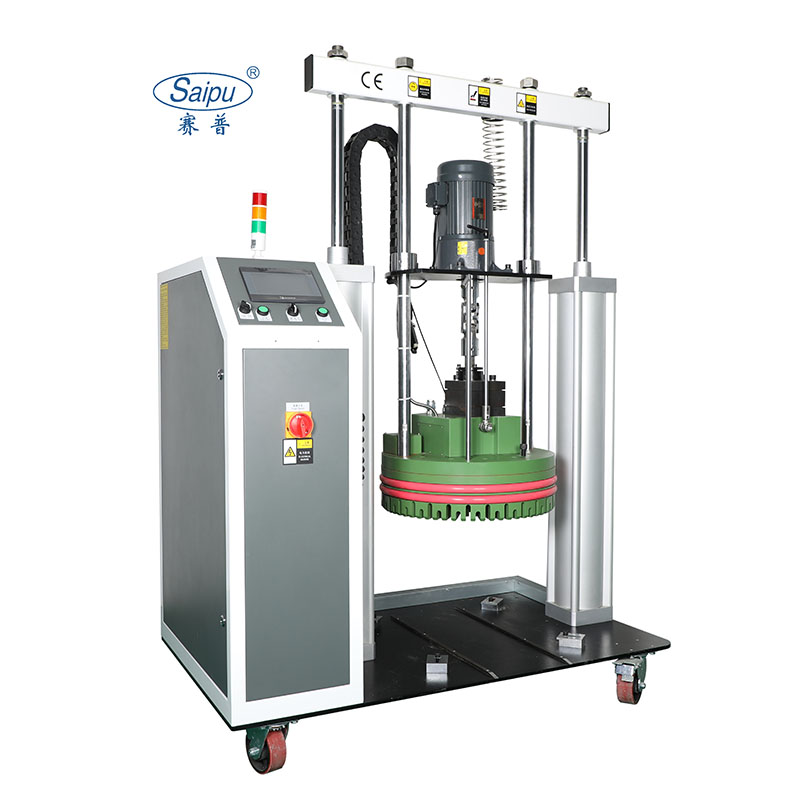
Sizing your equipment starts with basic physics. You must calculate the absolute maximum volume your line could potentially consume. Guesswork leads directly to system failures. Engineers rely on a specific core sizing formula to establish baseline requirements.
The calculation is straightforward: Line Speed (meters/minute) × Substrate Width (meters) × Application Weight (GSM) × 60 = Hourly Consumption in grams. You divide this final number by 1,000 to find your kilogram per hour (kg/hr) requirement. This mathematically proven method ensures your 200 kg PUR glue machine specifications align perfectly with real-world application demands.
Your calculated consumption is only the starting point. The machine's platen melt rate must exceed your maximum hourly consumption. Industry best practices dictate adding a safety margin of 15-20%. If your formula shows a 60 kg/hr consumption rate, a machine rated for exactly 60 kg/hr will struggle. A sudden drop in factory temperature forces the platen to work harder. Always specify a melt rate closer to 75 kg/hr for this scenario. This margin prevents line starvation during peak output intervals.
Line Speed (m/min) | Substrate Width (m) | Target GSM | Raw Consumption (kg/hr) | Recommended Melt Rate (+20%) |
|---|---|---|---|---|
15 | 1.2 | 60 | 64.8 kg/hr | 77.7 kg/hr |
25 | 1.2 | 50 | 90.0 kg/hr | 108.0 kg/hr |
30 | 1.5 | 40 | 108.0 kg/hr | 129.6 kg/hr |
Viscosity drastically alters theoretical calculations. Most manufacturers test equipment baseline specs using water or low-viscosity EVA. PUR adhesives behave differently. High-viscosity PUR formulations create immense fluid drag. They resist flow. This physical resistance reduces the practical delivery rate. When reviewing specifications, always demand flow curves based on your specific adhesive's viscosity at its recommended application temperature.
Pump selection defines application accuracy. Many operators ask why gear pumps are mandatory for precise flat lamination. Gear pumps trap a specific volume of fluid between rotating gear teeth. This mechanism guarantees exact volumetric displacement per revolution. They deliver a smooth, continuous, and ripple-free flow.
Piston pumps operate differently. They push fluid using a reciprocating motion. This creates inherent pressure pulses. Piston pumps suit intermittent extrusion tasks like box sealing. They fail miserably in continuous roll-coating. A piston pump pulse will create visible glue lines or varying coat weights on your finished laminated panels. A reliable 200 kg PUR glue machine dedicated to lamination must utilize a high-precision gear pump.
Continuous flow means nothing if the pump cannot adapt to changing line speeds. Automated lines speed up and slow down. Your drive system must synchronize precisely. This requires evaluating frequency inverters, also known as Variable Frequency Drives (VFDs).
The VFD controls the gear pump motor RPM. It must communicate directly with the main production line encoder. If the lamination line slows down by 10%, the gear pump must instantly reduce output by exactly 10%. This synchronization maintains a perfectly consistent GSM. Without this closed-loop feedback, deceleration causes over-gluing, while acceleration causes starvation.
Calculating pressure requirements ensures the motor has enough torque. Heated hoses create massive friction against viscous adhesives.
Determine the total length of the heated hose pathway.
Identify the inner diameter of the hose.
Calculate the viscosity of the PUR at the pumping temperature.
Estimate the required terminal pressure at the slot die or roller coater.
Longer hoses and narrower diameters multiply the required pump pressure. Your specified motor must overpower this total system resistance without overheating.
Standard off-the-shelf units work for simple single-point applications. Modern automated lines rarely fit this description. Specifying a custom 200 kg PUR glue machine becomes necessary when tackling complex fluid distribution.
Multi-hose and multi-channel configurations require specialized engineering. Some lines demand simultaneous adhesive feed to top and bottom coaters. Others feed multiple profile-wrapping heads simultaneously. You must size manifolds correctly. A single undersized manifold attempting to feed three hoses will experience severe pressure drops. Custom systems incorporate dual or triple independent gear pumps mounted on a single platen block. Each pump manages a dedicated hose channel. This guarantees isolated pressure control for every application head.
Facilities operating 24/7 cannot afford downtime for drum changes. Tandem system architecture solves this constraint. You install two 200 kg unloaders side-by-side. Both connect to a central automatic switchover valve. When Drum A empties, the system instantly triggers the valve. Drum B begins pumping immediately. Operators replace Drum A while production continues uninterrupted. This architecture represents the gold standard for high-volume enterprise manufacturing.
Integration extends beyond mechanical plumbing. Programmable Logic Controller (PLC) integration forms the nervous system of the line. Your equipment must speak the exact language of your master line controller. Custom builds ensure seamless data bridging.
Protocol Matching: Native support for Profinet (Siemens environments) or EtherCAT (Beckhoff environments).
Alarm Synchronization: Low-level warnings instantly trigger a controlled slow-down of the main line.
Remote Diagnostics: Maintenance teams monitor drive torque and zone temperatures from the central SCADA dashboard.
Handling large volumes of reactive polyurethane requires aggressive risk mitigation. Drum changeovers present the highest risk of operational failure. Minimizing downtime during this phase protects your production targets.
Evaluate the platen lift speed carefully. Slow pneumatic cylinders waste precious minutes. Large, high-flow pneumatic cylinders retract the platen rapidly. Bleed-valve efficiency also matters. As the platen presses into a new drum, it must expel trapped air. A poorly designed bleed valve traps air bubbles in the adhesive. These bubbles travel to the application head and create dry spots on your final product.
Moisture control is an absolute necessity. PUR cures rapidly when exposed to atmospheric humidity. Machine halts or drum changes introduce air into the environment. Assess whether your system includes dry air or nitrogen blanket systems. Injecting dry nitrogen over the exposed adhesive displaces humid ambient air. This prevents a cured skin from forming inside the drum.
Adhesive degradation often occurs due to poor thermal management. Zoned heating accuracy prevents this entirely. Your unloader needs precise, independent PID temperature controllers.
Heating Zone | Function | Tolerance Requirement |
|---|---|---|
Platen Base | Melts the top layer of solid adhesive | ± 2°C |
Pump Block | Maintains liquid state for gear displacement | ± 1°C |
Heated Hoses | Compensates for ambient temperature loss | ± 2°C |
Application Head | Achieves final viscosity for substrate application | ± 1°C |
If the platen overheats, it chars the adhesive. Charred particles act like sandpaper. They destroy gear pump teeth and clog expensive slot dies. Independent PID control ensures the adhesive steps up in temperature gradually as it travels through the system. This thermal profiling prevents premature cross-linking and preserves bond integrity.
Selecting the right vendor is just as critical as performing the engineering calculations. A 200 kg PUR glue machine supplier must function as an engineering partner, not just a catalog distributor.
Evaluate their technical competence first. During initial discussions, ask how they calculate hose pressure drops. Inquire about their methods for gear pump sizing based on viscosity curves. If they simply point you toward a standard model number without requesting your line speed or target GSM, look elsewhere. Real application-specific engineering requires deep mathematical modeling before a purchase order is ever signed.
Factory Acceptance Testing (FAT) represents your ultimate safety net. Demand comprehensive testing at the supplier’s facility prior to delivery. This is not a simple power-on test. The supplier must load the exact PUR adhesive formula you intend to use. They must pump it through the specified hose lengths at your maximum required flow rate. This physical proof eliminates nasty surprises during factory integration.
After-sales Service Level Agreements (SLAs) guarantee long-term success. Even the best equipment experiences wear. Inquire about replacement parts availability. Do they stock critical O-rings, temperature sensors, and replacement gear pumps locally? Check their local technician dispatch times. Strong suppliers provide concrete Mean Time To Repair (MTTR) guarantees. They understand that every hour of line downtime costs you heavily in missed deliveries.
Sizing a high-capacity drum unloader is a rigorous engineering calculation. It goes far beyond simply matching a barrel size. You must carefully balance total hourly consumption against pump capacity and adhesive viscosity. Precision drive systems ensure your application weight remains consistent, regardless of line speed fluctuations. Taking proactive steps to control moisture and manage thermal zones protects your adhesive from catastrophic degradation.
Compile your maximum line speed, maximum substrate width, and target coat weight immediately. Locate your adhesive’s Technical Data Sheet (TDS) to understand its exact viscosity curve.
Do not leave your automated production line to chance. Engage a specialized engineer or an established equipment manufacturer today. Request a customized flow calculation and let them draft a preliminary machine specification tailored exactly to your floor operations.
A: Generally 45 to 90 minutes, depending on the platen wattage and the thermal conductivity/viscosity of the specific PUR adhesive at room temperature.
A: Yes, provided the total combined consumption does not exceed the platen's maximum melt rate, and the pump manifold is sized with dual independent gear pumps.
A: Ensure the machine is equipped with a high-quality O-ring seal on the platen, utilize standby temperature drop features, and implement a dry-air or nitrogen injection system.


